Quick answer: A “Small Apple” floodlight (小苹果投光灯) is the slim, flat LED floodlight with rounded corners and a full tempered-glass front that most Chinese factories make today. UK and Australian wholesalers call the same style a tablet floodlight. Inside, it is a die-cast aluminum housing, an SMD LED board and either a driver-on-board (DOB) or a separate driver. Before ordering, check real input power, lumens, housing weight, glass, cable gland, voltage range and certificates for the exact model.
By Seam Xiao, Export Sales Manager, SFY Smart Lighting · Updated October 2026
Key takeaways
- “Small Apple”, “Apple-style” and “tablet floodlight” are trade nicknames for the same slim design, not brands.
- Most of the price difference between suppliers comes from housing weight, LED count, driver design and sealing, not from the shape.
- A plug-in power meter and a kitchen scale reveal more about a sample than a datasheet does.
- Match the input voltage to your market: wide-voltage DOB (AC85–265V) works on 110V and 230V grids; linear DOB versions are usually for 220–240V only.
Why is it called a “Small Apple” or tablet floodlight?
When this thin, flat floodlight replaced older, deep-bodied floodlights, Chinese lighting traders compared its rounded corners and glass face to a tablet computer and nicknamed it 小苹果 (“Small Apple” or “Little Apple”). The nickname stuck, and you will now see it in thousands of supplier listings. Different markets use different names for the same product:
| Name | Where you will see it | Notes |
|---|---|---|
| 小苹果投光灯 / 苹果款投光灯 | 1688, Taobao and Chinese factory catalogs | Literally “Small Apple floodlight” / “Apple-style floodlight” |
| Small Apple floodlight | English listings on Alibaba and AliExpress | Direct translation used by Chinese exporters |
| Tablet floodlight / PIR tablet floodlight | UK and Australian electrical wholesalers | “PIR” is added for the motion-sensor version |
| Slim / ultra-slim LED floodlight | Most supplier websites | The most common generic term |
| DOB / driverless LED floodlight | Technical datasheets and trade buyers | Describes the driver design, not the shape |
However, none of these names refers to Apple Inc. They describe a shape, so two “Small Apple” floodlights from different factories can perform very differently.
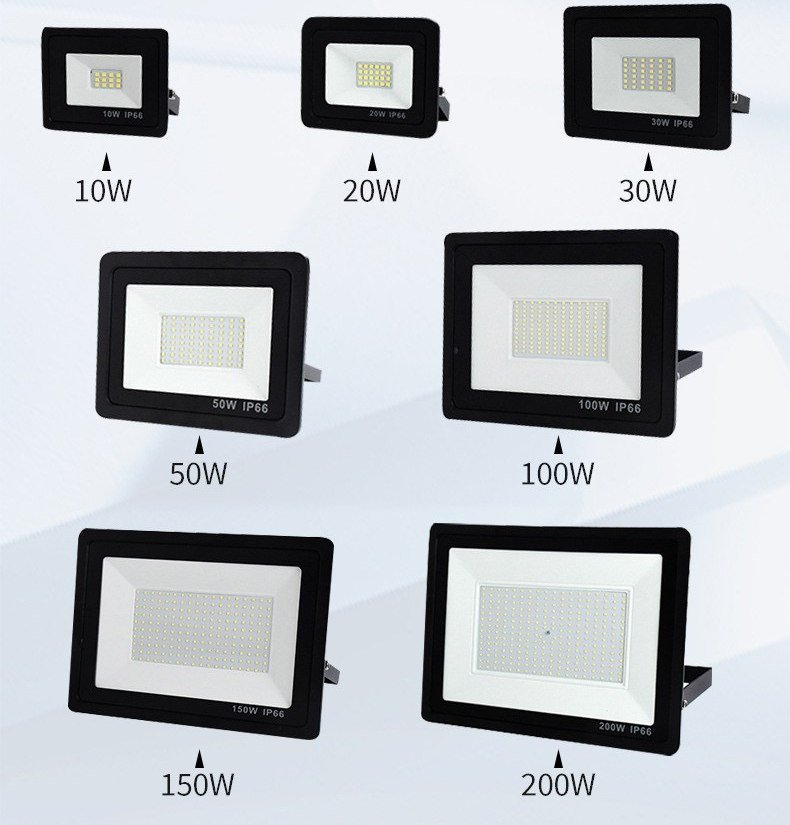
What is inside a Small Apple floodlight
- Housing: die-cast aluminum with cooling fins on the back. Its mass and fin area decide how hot the LEDs run.
- Front: tempered glass over a white reflector. However, cheaper versions sometimes use plastic, which yellows outdoors.
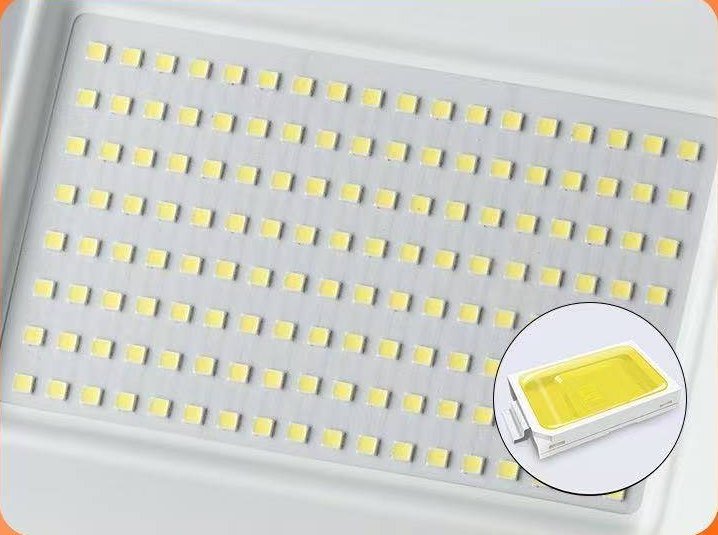
- LED board: usually SMD2835 LEDs on an aluminum board.
- Driver: either built onto the LED board (DOB, driver-on-board) or a separate driver inside the housing.
- Cable entry: a waterproof cable gland. Better designs add a breather that equalizes pressure, so the lamp does not suck in moist air as it cools and fog up inside the glass.
- Bracket: a U-bracket for wall, ground, ceiling or pole mounting. Sensor versions add a PIR head under the frame.
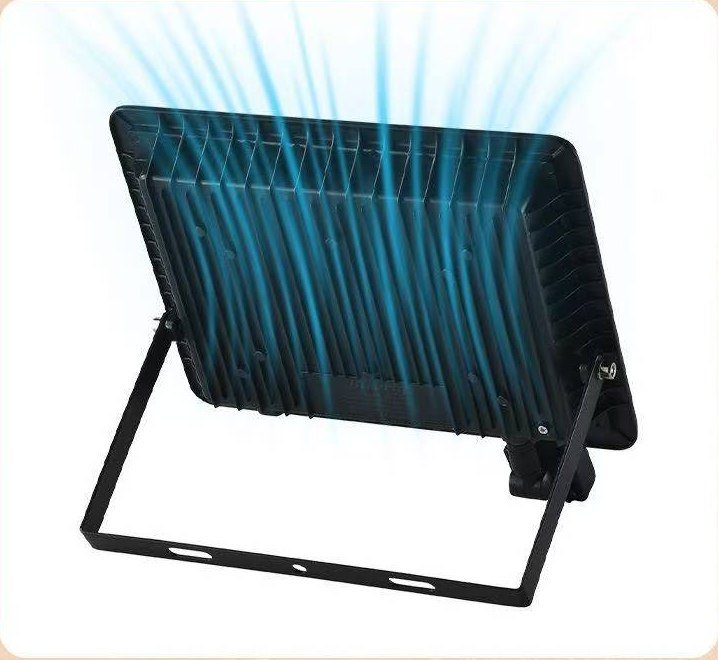
DOB (driverless) vs separate driver
Most slim floodlights in this price range now use a DOB design. However, it is not automatically better or worse; it simply suits different markets.
| DOB (driver on board) | Separate driver | |
|---|---|---|
| Profile | Very slim, fewer parts and connections | Needs space for the driver box |
| Cost | Lower | Higher |
| Voltage | Wide-voltage versions (AC85–265V) exist; linear versions are usually 220–240V only | Depends on the driver chosen |
| Repair | LED board and driver are replaced together | Driver can be replaced on its own |
| Typical use | Wholesale, retail and general outdoor lighting | Projects that specify a branded driver, dimming or high surge protection |
7 checks before you order Small Apple floodlights
1. Measure the real input power
Plug the sample into a power meter (a low-cost plug-in meter is enough) and compare the reading with the label. In low-cost listings it is common for a lamp sold as “100W” to draw much less. Therefore, ask suppliers to quote measured power, not “equivalent” watts.
2. Ask for lumens, not just watts
Instead, compare quotes on luminous flux and efficacy (lumens per watt), ideally from an integrating-sphere test of the exact model. Our SF-FL01 and SF-FL02 series are rated at least 90 lm/W, so a 100W model delivers at least 9,000 lm.
3. Weigh the housing
Aluminum is the expensive part of a floodlight, and it is also what carries heat away from the LEDs. As a result, a heavier body at the same wattage usually means thicker walls and more fin area. Our own two series show the difference clearly:
| Power | SF-FL01 heavy-duty DOB | SF-FL02 PIR sensor (incl. sensor) |
|---|---|---|
| 50W | 0.53 kg | 0.45 kg |
| 100W | 1.00 kg | 0.83 kg |
| 150W | 1.35 kg | 1.10 kg |
| 200W | 1.88 kg | 1.25 kg |
Net lamp weights from our current packing data.
For this reason, when two quotes for “the same” 200W tablet floodlight differ a lot in price, put both samples on a scale before deciding.
4. Check the glass
Tempered glass stays clear and resists impact and heat. In contrast, plastic fronts are lighter and cheaper but can yellow and crack in strong sun.
5. Look at the cable gland
In fact, water usually gets in where the cable enters, not through the glass. Also, ask whether the gland is sealed and whether there is a breather to stop fogging. Our floodlights use a waterproof gland with an anti-siphon breather.
6. Match the voltage to your market
For example, 110–120V markets need a wide-voltage model. Our Slim DOB LED Floodlight runs on AC85–265V. Our PIR sensor tablet floodlight uses a linear DOB design for AC165–265V, which suits Australia, the Middle East, Europe and other 220–240V markets.
7. Get documents for the exact model
Ask for the IP test result and the certificates your market needs (for example CE for Europe, or SAA approval under Australia’s Electrical Equipment Safety Scheme), and check that the model numbers on the documents match the products you are buying. For a full pre-shipment routine, see our LED lighting quality checks before export.
Choosing wattage: quick starting points
These are typical starting points, not a lighting design. Mounting height, the area to cover and the light level you need all change the answer.
| Application | Typical wattage | Version |
|---|---|---|
| Porch, entrance, side passage | 10–30W | PIR sensor |
| Yard, driveway, garage front | 30–50W | PIR sensor or always-on |
| Building façade, warehouse wall, car park | 100–200W | Always-on DOB |
| Billboard, sports court, construction site | 150–400W | Always-on DOB |
SFY tablet (“Small Apple”) floodlight series
- Slim DOB LED Floodlight (SF-FL01): 10–400W, AC85–265V wide voltage, heavy-duty die-cast housing, IP66.
- PIR Sensor LED Tablet Floodlight (SF-FL02): 10–200W, 8–12 m PIR detection with an adjustable head, AC165–265V, IP66.
Both series deliver at least 90 lm/W, offer 3000K–6500K, use tempered glass and carry CE and SAA. Compare them side by side on our LED floodlights page. Not sure whether you need PIR or microwave sensing? Read PIR vs Microwave Sensor Lights.
FAQ
Is “Small Apple” a brand?
No. It is a Chinese trade nickname for the slim, round-cornered floodlight shape. Many factories make it; as a result, quality varies widely.
Is a tablet floodlight waterproof?
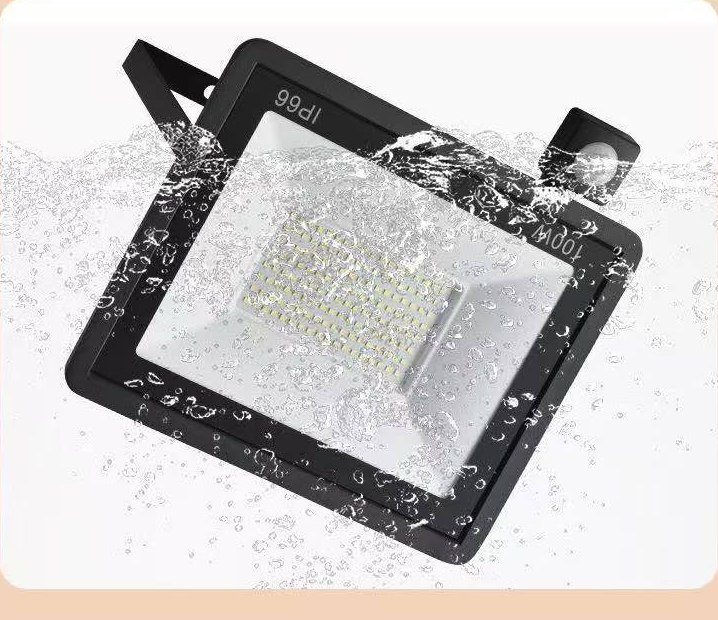
Good ones are sealed to IP65 or IP66 (see how the IP code works). Check the rating on the label and ask for the test result. Our series are IP66.
Which version should I choose for Australia?
Australia runs on 230V, so both our DOB series (AC85–265V) and our PIR sensor series (AC165–265V) are suitable. Ask for the SAA documents for the models you order.
Can I get a motion-sensor version?
Yes. The SF-FL02 PIR sensor tablet floodlight switches on when people approach, with adjustable delay, light level and sensitivity.
What color temperatures are available?
3000K warm white to 6500K cool daylight.
Need a quotation? Send the model, quantity, color temperature and destination market through our contact page or WhatsApp.