
Motion sensor lights can improve convenience, security and energy management, but different sensing technologies behave differently in real installations. For wholesalers and project buyers, choosing between PIR and microwave sensing should be based on the environment, coverage requirements and expected user behavior.
How PIR sensing works
A passive infrared sensor detects changes in infrared energy within its field of view. In practical terms, it responds when a warm moving object such as a person passes across the detection zones. PIR sensors do not transmit a signal into the surrounding space.
PIR sensor lights are commonly used around entrances, yards, paths, garages and exterior walls. They can be a practical choice when the buyer wants motion activation focused on a defined visible area.
How microwave sensing works
A microwave sensor emits a high-frequency signal and detects changes in the reflected signal caused by movement. Depending on the product design and installation materials, microwave sensing may respond through some non-metallic barriers and can detect smaller movements.
This sensitivity can be useful in corridors, utility areas, stairwells and some commercial applications, but it also means that positioning and settings require careful confirmation.
Key differences for product selection
Detection behavior
PIR detection is influenced by the movement direction, temperature contrast and unobstructed view of the target area. Microwave detection can be more sensitive to movement and may cover areas that are not directly visible to the sensor.
Installation environment
For outdoor security lighting, the housing protection level, mounting height and sensor orientation are as important as the sensing method. For indoor applications, buyers should consider walls, doors, adjacent spaces and potential unwanted triggering.
Adjustment options
Sensor products may provide adjustments for detection range, operating time and ambient-light threshold. The available controls vary by model. Buyers should confirm whether adjustments are made by dials, switches, remote control or fixed factory settings.
False triggering
No sensor technology is free from installation-related false triggering. Moving vegetation, traffic, animals, heat sources, reflective surfaces or movement behind a wall can affect the result depending on the sensor type. Sample testing in a representative environment is strongly recommended.
Questions to ask before ordering
- Will the light be used indoors or outdoors?
- What is the mounting height and preferred detection area?
- Should the sensor detect only visible movement or broader movement?
- What operating time and daylight threshold are required?
- Is manual override required?
- What wattage, light output and beam direction are needed?
- What input voltage and wiring arrangement applies?
- What housing color, logo and packaging are required?
Single-head, dual-head and multi-head designs
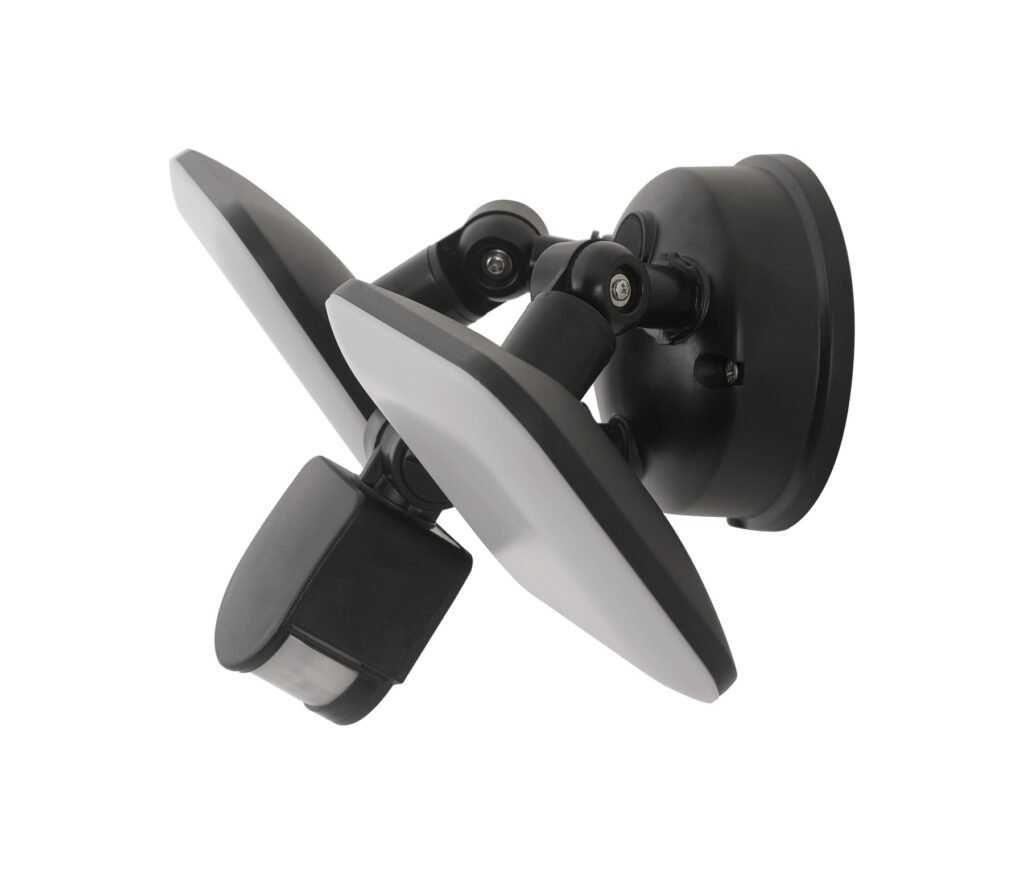
The number of light heads affects coverage and aiming flexibility. A single-head product may suit a focused entrance or path. Dual-head and multi-head products can cover wider areas or allow light to be directed in different directions. The sensor position should remain clear after the heads are adjusted.
See representative configurations on our LED Sensor Lights page.
Sample confirmation is essential
Sensor range values measured under controlled conditions may differ from the final installation. Before a bulk order, confirm the sample at the intended mounting height and in a similar environment. Test the detection direction, activation time, daylight function, manual override and coverage of each light head.
Request a sensor light recommendation
Tell SFY the installation location, voltage, preferred head configuration, sensing method and estimated quantity. We can discuss suitable models, customization and wholesale quotation requirements.
Discuss sensor lights on WhatsApp or send your requirements.